Neko Toji: sharing a little of the cats’ everyday life
The cats live here at their own pace. Neko Toji is our name for the time guests spend alongside them, with room to enjoy the countryside without a packed schedule.
Published by Washinmura
Washinmura is a small countryside village where you can stay overnight in Futtsu, Chiba.
You pause as a cat walks through the garden.
You sit nearby and share a little of its day.
If one is sleeping by the veranda, you lower your voice and settle close by.
If it seems comfortable, you might gently stroke its back.
You sit quietly for a while, watching the fire burn down.
These small, ordinary moments matter to us at Washinmura.
We are visitors in the countryside the cats call home. Giving them whatever space they need that day, we settle into their pace, the sounds of the fire, the scent of wood and the changing seasons.
At Washinmura, we call this way of spending time Neko Toji.

Neko Toji: time in the countryside, alongside cats
The name draws on the Japanese word toji.
Toji traditionally means spending an extended time at a hot spring: soaking, staying in one place and letting the tiredness of everyday life ease, without rushing towards an answer.
Neko Toji brings that idea to Washinmura, where the time you share is with cats in the countryside.
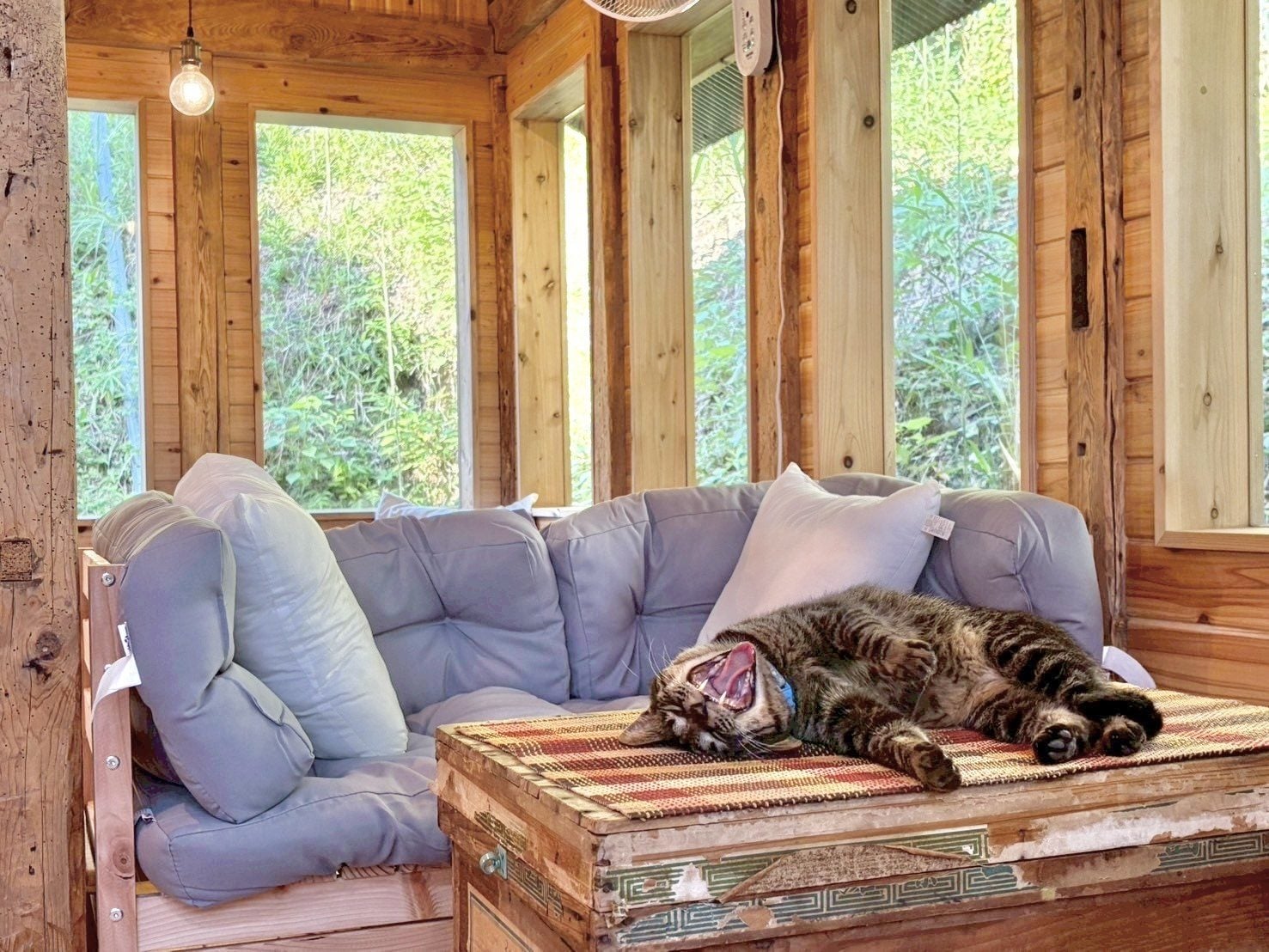
Where toji gives you time in the hot spring, Neko Toji gives you time in the rhythm of the countryside where the cats live.
The presence of cats, the crackle of fire, the scent of wood, insects calling at night. An unhurried day around the Kominka, Nagayamon, Nordic tents and Jyubako cabins.
For a while, you can let go of your usual hurry.
A central part of Neko Toji is allowing the cats to carry on with their lives, without making them fit our plans.
We visit a place where they are already at home. Learning to enjoy whatever distance they choose is part of a stay here.
This is the cats’ home
The cats at Washinmura spend their days here in the countryside.
They walk through the garden, rest by the veranda, seek out shade and sometimes choose a spot right beside a guest.
That is why we ask guests to keep a few simple things in mind.
Approach calmly. If a cat seems happy for you to sit nearby, settle beside it. If it is comfortable with touch, stroke it gently. When taking photos, leave its path—and its way away from you—clear.
These small courtesies are part of Neko Toji.
Sometimes a cat will stay close. Sometimes you will watch one from farther away, or catch sight of one crossing the back of the garden. Near or far, the cats are simply going about their day.
Accept that distance, without trying to hurry them.
That is where time with the cats at Washinmura begins.
As with toji, stay a while and take your time
In everyday life, doing nothing can make us feel restless.
We fill the diary, take the photos and move on to the next place. Before long, we are checking our phones again, wondering whether we have missed a message.
At Washinmura, time can feel a little different.
You wait for the fire to catch, then for the charcoal to glow. You notice the evening air cooling and listen to what is happening in the garden.
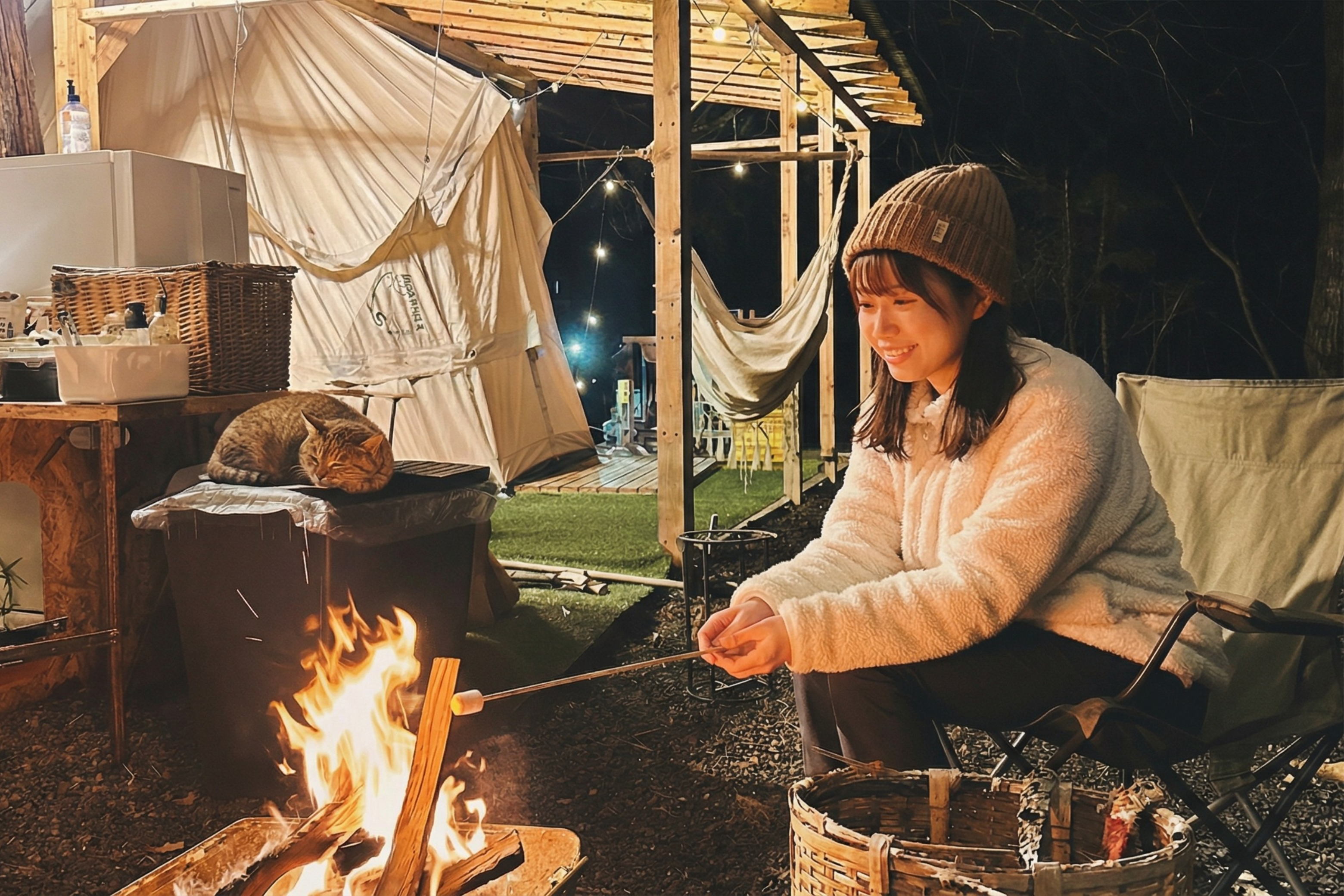
Here, that waiting is part of the pleasure of travelling.
As you watch the fire, voices may grow quieter. Sounds from the far end of the garden become easier to hear. You suddenly notice the pace of a passing cat.
You begin to make a little room for doing nothing.
That feeling is at the heart of Neko Toji.
What makes up Neko Toji?
The cats’ freedom, the quiet landscape, time beside a fire and the sense of the outdoors just beyond your room all come together in Neko Toji at Washinmura.
At the cats’ pace
Cats do not follow our schedules.
When we make room for their freedom, we often slow down too. It is lovely to meet one; when we don’t, we know they are somewhere in the same village, living their day.
Respecting their pace is the starting point for a stay here.
Fire and time in the countryside
Evenings at Washinmura include time around a fire.
BBQ charcoal, a crackling fire, the heat of a wood-fired sauna. None of it happens instantly: you wait for the fire to catch, for it to grow, then watch it burn low.
That waiting is part of Neko Toji, too.
The quiet around your room
The Kominka, Nagayamon, Nordic tents and Jyubako cabins.
Washinmura has several room types. Around each are gardens, places for a fire, outdoor sounds and morning light.
Even indoors, the world outside still feels close.
Those moments belong to Neko Toji as well.
What the name means to us
Neko Toji is written 猫治 in Japanese, using the character 治.
We do not use it in a medical sense. It is a metaphor drawn from toji: staying somewhere for a while and allowing a little of daily life’s hurry to ease.
What matters to us is spending unhurried time in the countryside the cats call home, sharing the same air.
Watching a cat cross the garden or sleep a little way off, you may notice your own shoulders relax.
We call that quiet time Neko Toji.
If glamping brought you here
Perhaps you found Washinmura while looking for a glamping stay in Chiba or Futtsu.
We are glad you found us.
Calling Washinmura a glamping site does not quite tell the whole story.
We do have Nordic tents, BBQs and the pleasure of staying close to nature.
Time at Washinmura reaches a little further into village life.
The Kominka, Nagayamon and Jyubako cabins sit among the countryside. Rescued cats live here. You wait for a fire or step back into the forest air after a wood-fired sauna. For a while, you become a visitor to this village, respecting the cats’ pace.
Washinmura is a small village where you can stay overnight and spend time in the same countryside as the cats. Neko Toji is the name we give to that experience.
When choosing where to stay, think about how you would like to spend your time in the village, too.
We will keep sharing stories of village life and time with the cats on this blog.
Passing on the countryside’s landscape
We have restored buildings that were already part of this place—including a roughly 200-year-old farmhouse and the historic Nagayamon gatehouse—so guests can stay in them. Nordic tents and Jyubako cabins are dotted among the trees, following the shape of the land.
Marks in old timber, the garden seen from a veranda, wind through a gateway and plants changing with the seasons: each is part of a stay here.
Wait for the fire to grow, notice the animals nearby and listen to the countryside at night. We hope you can take your time with the landscapes and rhythms that still remain in rural Japan.
Washinmura—Neko Toji Village—suits guests who want to rest in nature, take their time around a fire and enjoy being near animals.
Who might enjoy Neko Toji?
People who like cats.
And who are happy to share a place with them while respecting the space they choose.
People who enjoy the sounds of nature, waiting for a fire, old wooden houses, a morning garden and insects calling at night.
People who would rather leave some time unplanned than fill every hour of a trip.
For these guests, Neko Toji may feel like a good fit.
It is a stay for people who want to enjoy lighting a fire and preparing a meal as part of taking their time in the countryside.
We hope it finds its way to people who feel at ease with the cats’ pace and the quiet of this landscape.

Frequently asked questions
Is Neko Toji a medical treatment?
No. Neko Toji is not a medical treatment. It describes spending time at Washinmura, where cats live, and easing out of the daily rush with the fire, the breeze and the quiet around your room.
Am I guaranteed to meet a cat?
The cats live freely at Washinmura and may not choose to approach you. You may see them around the grounds, but when they appear and how close they come are up to them.
How is this different from glamping?
You can enjoy Nordic tents, BBQs and an overnight stay in nature. There is also the everyday life of a small village: rescued cats, time around a fire, the quiet outside your room and the changing seasons.
Can I bring my pet?
Since September 2025, guests have not been able to bring pets for either overnight stays or visits. This policy helps protect the health and peace of the animals who live at Washinmura.